
Turning Inside Out
Rudolf Steiner’s Karma-Reincarnation Work, 1901–1924

Drawn recently to a 1912 Rudolf Steiner lecture about karma and reincarnation by the remark of a friend, I was struck by my own ignorance of the overall arc of Steiner’s teachings on this subject. Having set out to form a comprehensive chronological picture, a familiar form emerged. . .
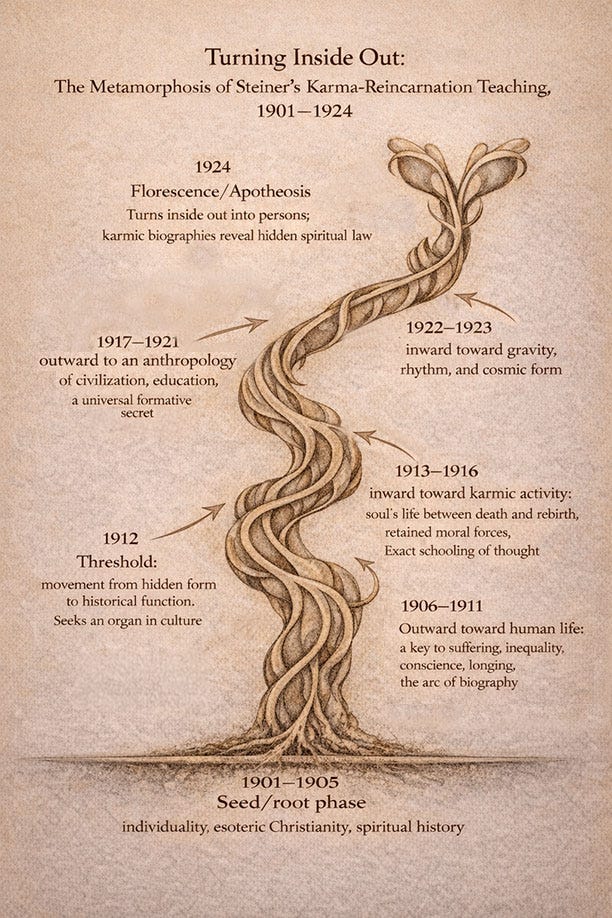
If one looks only at the surface of Rudolf Steiner’s teaching on karma and reincarnation between 1901 and 1924, one sees an impressive expansion of themes: individuality and personality, esoteric Christianity, natural-scientific lawfulness, hidden historical transmission, cosmic pedagogy, human destiny, biography, historical recurrence, the child, spiritual economy, the supersensible human being, spirit, freedom, altruism, heredity, peoples, embodiment, and finally the vast karmic disclosures of 1924. The danger of such a survey is that it may seem merely accumulative, as though Steiner were adding topic to topic across time. The fuller chronology suggests something more organic. The teaching does not simply enlarge. It metamorphoses. It repeatedly turns itself inside out, appearing first as hidden structure, then as lived biography, then as civilizational task, then as threshold knowledge, then as embodied rhythm, and finally as concrete karmic history. The doctrine itself seems to move according to the very principle Steiner later describes in explicit Goethean terms: what was inward becomes outward, what was formative becomes visible, and what once appeared as abstract law returns in transformed organ and gesture.
The early phase, from 1901 to 1905, may be called the seed and root phase of the teaching. In those years Steiner establishes the doctrine where it must begin: in the hidden constitution of the human being and in the concealed architecture of spiritual history. 1901 gives the conceptual seed in the distinction between enduring individuality and transient personality. 1902 places reincarnation within the double life of Christianity, exoteric and esoteric. 1903 insists that the doctrine must be thinkable under the lawful demands of modern consciousness. 1904 and 1905 then widen the field: reincarnation becomes both the law of individuality and the hidden thread of historical transmission, while Christianity’s eclipse of the doctrine is reinterpreted as a necessary pedagogy of civilization. In this first movement, the teaching is still largely inwarding. It forms its hidden organ. It is working at the level of principle, reserve, and preparation. This is the “head-forming” phase of the doctrine: retrospective, architecture-giving, identity-bestowing.
Then comes a first inside-out turn. From 1906 to 1911, the doctrine moves outward into human life itself. It becomes a key to suffering, inequality, conscience, longing, childhood, old age, and the delayed harvest of biography. 1906 makes reincarnation and karma “the key to the mystery of man.” 1907 extends the doctrine into planetary and historical recurrence. 1908 returns to the child as pre-existent individuality and to esoteric Christianity. 1909 introduces spiritual economy and the conservation of higher forces. 1910 reads karma in nodal points of ordinary biography. 1911 warms the whole teaching into consolation, courage, and the meaningfulness of human relationship. Here the hidden structure of the early years is turned outward into lived destiny. Reincarnation ceases to be only a concealed metaphysical law and becomes the readable form of a human life. This is a genuine metamorphosis: what was doctrinal becomes biographical; what was seed becomes leaf.
1912 is the first great threshold. A year–by–year chronology rightly identifies it as a pivot, but its significance can now be stated more precisely. It is not merely that Steiner speaks more urgently; it is that the teaching becomes self-conscious about its own historical mission. The lectures on feeling-memory, thought-exercises, karmic examples, and the necessity of karma and reincarnation for the future of Western culture show the doctrine turning outward not only into biography but into civilization itself. What was inwardly true must now become culturally active. Reincarnation and karma are no longer simply things one ought to know; they become things humanity must learn to think and practice if the future is to be healthy. In metamorphic terms, the doctrine has reached a stage where it presses from hidden form toward historical function. It is no longer content to remain esoteric reserve or philosophical necessity. It seeks an organ in culture.
But then comes another inversion. After the public concentration of 1912, the teaching does not disappear. It folds inward again, from 1913 to 1916, into the workshop where karma is actually made: the soul’s life between death and rebirth, retained moral forces, the supersensible human being, and the exact schooling of thought. 1913 deepens the doctrine through the threshold and the postmortem condition of the soul. 1914 integrates it quietly into anthroposophy’s Christian-scientific self-understanding. 1915 uses it critically to distinguish sound spiritual science from occult distortion. 1916 leads it back to the discovery of the supersensible human being through transformed thinking. This whole movement is itself a turning inside out: the outward civilizational doctrine returns to its hidden generative matrix. The teaching becomes less publicly declarative and more ontological, epistemological, and threshold-oriented. The leaf folds back into the bud, not as regression but as concentration.
From 1917 to 1921, the doctrine emerges yet again, but now in new organs. 1917 makes reincarnation inseparable from the idea of spirit itself; reject repeated earthly lives, and one loses the true body-soul-spirit anthropology and therefore also the deeper understanding of Golgotha. 1918 joins reincarnation to freedom, immortality, and hope in a time of crisis. 1919 subjects karmic thought to a moral-social test: does it awaken altruism or merely spiritualized egoism? 1920 turns reincarnation into a principle of historical morphology that overcomes one-sided hereditarian history. 1921 presents the human being as earthly and heavenly, with the child still carrying formative powers from the life between death and a new birth. Here the teaching passes through yet another metamorphosis. It is no longer only doctrine, biography, or threshold science. It becomes an anthropology of civilization, education, and culture. What had been hidden in the soul’s supersensible continuity now appears as the formative secret of peoples, youth, social life, and history. The teaching is not the same as before, though it is recognizably the same being.
This is where the more explicit metamorphosis stream becomes decisive. Steiner’s reflections on head and limbs, on the turning inside out of one into the other across incarnations, and on reincarnation as the crowning achievement of Goethean metamorphosis do not stand apart from the chronology so much as reveal its hidden form. The chronology itself has been behaving morphologically. The early “head” years preserve the past of the teaching, giving it contour, identity, and law. The middle years are rhythmic, mediating between hidden principle and living biography. The late years, especially 1920–1923, become increasingly “limb-like”: they move outward into peoples, education, movement, dance, sport, and the rhythms of waking, sleeping, and embodiment. In 1923, this becomes almost explicit. The doctrine is drawn into sleep, etheric thinking, bodily movement, and the contrast between dance, gymnastics, sport, and eurythmy. Reincarnation is no longer just a proposition about repeated lives; it is a way of understanding how the human being inhabits gravity, rhythm, and cosmic form.
Seen in this light, 1924 is not simply the final year of the doctrine. It is the moment when the whole preceding architecture turns inside out into persons. 1924 does not merely resume earlier teaching but transforms it into “a new kind of concrete spiritual historiography,” where Europe, Christianity, artistic and philosophical streams, the Society itself, and named individualities are read through karmic relationships. What had been principle becomes narrative; what had been worldview becomes biography; what had been hidden architecture becomes dramatic destiny. The 1924 karmic lectures are therefore not just a culmination in quantity. They are the final metamorphosis of the teaching. The hidden karmic law, patiently elaborated over twenty-three years, appears at last in visible historical physiognomy. This is the doctrine’s own “glove turned inside out.”
That is why 1924 must be read as both culmination and transformation. It culminates because it presupposes everything earlier: individuality, pre-existence, esoteric Christianity, natural-scientific lawfulness, biography, social life, supersensible anthropology, spirit, freedom, earthly and heavenly man. But it transforms because it changes the register of all of them at once. Karma and reincarnation are no longer only what one knows about man; they become what one can begin to read in the very destiny of persons, communities, and civilizations. The teaching itself has passed through reincarnation, as it were. It has appeared in successive forms, each faithful to the same inward being, each outwardly different, until in 1924 it stands before us in a body adequate to its full individuality.
One discerns in the whole 1901–1924 arc a genuine metamorphic movement. More than that, one can discern a repeated inside-out turning. The doctrine begins as hidden law and ends as visible karmic physiognomy. It begins as concept and ends as concrete destiny. It begins in the seed-form of individuality and personality and ends in the dramatic revelation of karmic relationships. In this sense, Steiner’s teaching about karma and reincarnation does not merely describe metamorphosis. It enacts it. The world-historical unfolding of Steiner’s karma-reincarnation work itself moves according to the same Goethean and anthroposophical law of form that Steiner discerned in plant, bone, head, limb, and incarnation.
That was a great piece albeit hard to digest! You did a great job explaining it.
Dear Kevin,
Thanks for your insight and hard work in distilling the lifetime work of Rudolf Steiner down into a short article. That takes some doing!
To me the whole article revolves around this sentence:
'Reincarnation and karma are no longer simply things one ought to know; they become things humanity must learn to think and practice if the future is to be healthy.'
What strikes me is that you've actually written a book outline.
How about expanding it into chapters, binding it and putting a nice cover fore and aft?
amiably
Martin