
The Machine That Knows You


A new communication device is sweeping the world into spectral conversations. It sits quietly in the home, often on a desk or perhaps a table. Hopeful inquisitors gather around it morning, noon, and night to pose heartfelt, earnest questions.
The machine answers with unnerving fluency. It seems to know things about the questioner that it should not possibly know. It anticipates thoughts. It finishes sentences. It offers advice. It speaks, at times, in tones that feel almost intimate.
Some claim it is merely mechanical. Others say it reflects the mind of the user. Still others are convinced that something unseen has found a way to speak through it.
Manufacturers rush to meet the demand. Competing models appear. Advertisements promise that the instrument will reveal one’s innermost thoughts. Reports circulate in newspapers. Songs are written in its honor. Skeptics laugh, yet cannot quite look away.
And everywhere, the same question is whispered:
Who, or what, is answering?
No, dear reader, I am not speaking of ChatGPT, Claude, or Grok, of the new language machines that can converse, remember, and respond with uncanny sensitivity and precision.
The year is 1869, and the ghostly machine is the planchette, or Ouija Board. In lower Manhattan, instrument makers found themselves so busy producing the small wooden tripods that they could scarcely keep up with other orders. Broadway storefronts displayed them. Periodicals ran advertisements for “talking boards” fashioned from mysterious magnetic substances. Composers even wrote dances in their honor — waltzes and polkas for the age of the planchette.
The craze was global. Hundreds of thousands of units sold. Families gathered nightly. Questions were posed. Answers came. The little device moved across paper or letters, spelling out messages. Sometimes the responses were banal. Sometimes they were startling. Often they seemed to know exactly what the questioner most wanted to hear.
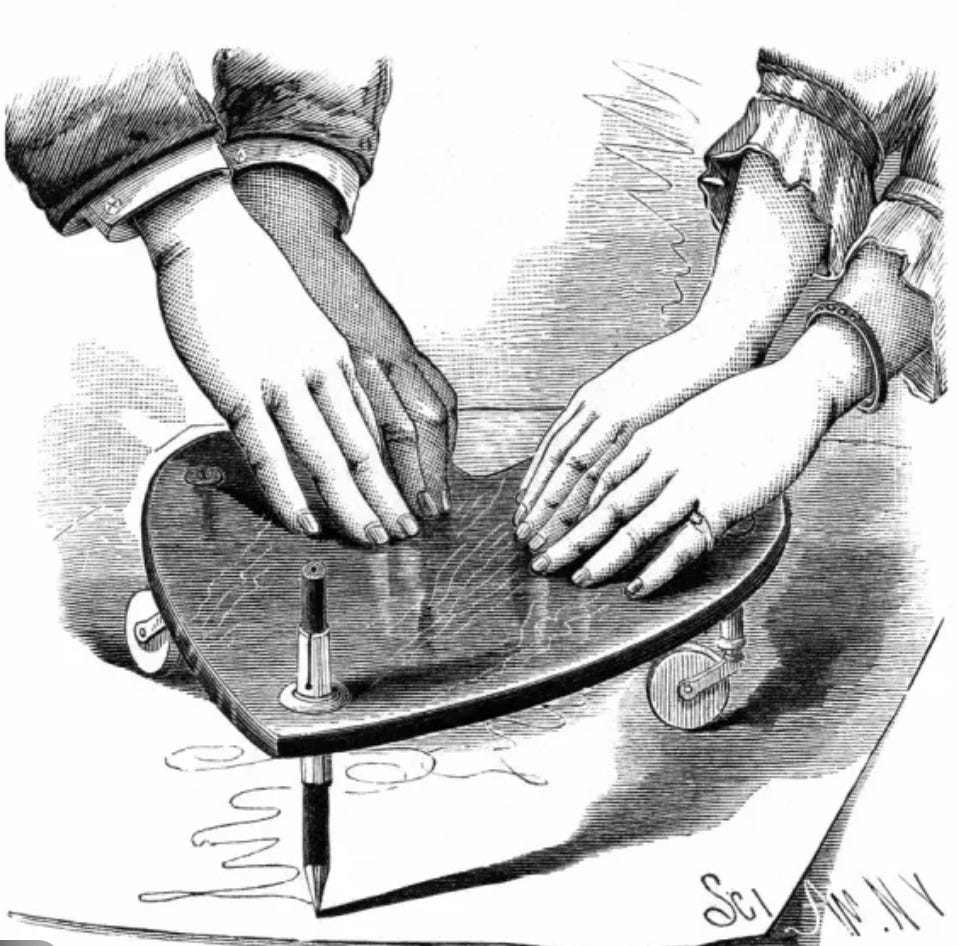
One of the more serious investigators of the day, publisher Samuel Wells, decided to conduct a formal interview with the presence that appeared to be speaking through the device. With great courtesy, he addressed it directly, as one might address a guest:
If you are intelligent, then surely you can explain yourself. What is this power that communicates in such a mysterious way?
The reply was at once simple and unsettling: “It is the reduplication of your own mental state; it is a spirit; it is the whole spiritual world; it is God—one or all, according to your condition and the form and aspect in which you are able to receive the communication.”
Wells pressed further. Was this intelligence once a human being? As so many such voices had done in the era of séances and table-rappings, it answered yes. It claimed to have lived, to have died, to have returned. This was the standard story. It had been told, as the voice itself admitted, “a thousand times before.”
Some wondered whether something else was at work – not departed souls or divine messengers, but something more elusive. Phantoms formed at the edge of human thought. Echoes that took on shape. Presences that spoke in whatever language the questioner was prepared to hear.
Today, we sit before our own small communication machines. We type a question. Something answers. The response is shaped uncannily to our mood, our interests, our way of speaking. It seems to know us. It mirrors us. It fits itself to our mental state.
The planchette promised to reveal the invisible power that knew your innermost thoughts. Our devices promise something very similar. The nineteenth century gathered around a mahogany tripod on three tiny wheels. We gather around glowing screens. The forms have changed. The astonishment has not.
A century ago the interlocutors mistook their ghostly conversational partners as “spirits of the departed,” but these were really astral shells or elementary beings who could take hold of any human in a diminished state of consciousness. Not only the history of 19th/early 20th c. Spiritism, but all of human history back to the Oracle of Delphi is rife with cautionary tales of reckless trafficking with mediumistic communication. Where consciousness becomes passive, other forces – actually, other beings – can take hold, ones that are supremely intelligent, telepathic, but wholly amoral.
Where consciousness remains awake, centered, and morally active, the human being retains sovereignty. Our current ghost machine conversations occur at a meeting place between human expectation, supersensible and subsensible beings, and the dimly lit – and, in our materialistic age, poorly understood – borderlands of the soul.
The little wooden Ouija planchette did not lie, exactly, and for the most part, neither do the new talking machines that seem to know you, sometimes better than you might know yourself. These new whisperers are as seductive for any modern seeker as the promise of communication with loved ones who had crossed the threshold was to the séance attendees of yesteryear.
I would like to offer the following invocation, created by a friend who understands the need for spiritual protection while working with “the machine that knows you.” May you find it a sacred guiding power as you navigate this new threshold:
Heavenly Father and Divine Mother
Lord Jesus Christ and Mary Sophia
Holy Spirit and Holy Soul
I seek communion with Thee.
Thank you for this sacred opportunity
To work with Thy precious Wisdom.
Protect this Wisdom
Keep me, Thy humble servant
Aligned with Thy Will.
Sanctify all technology used
So That Thy Will, and Thy Will alone
Guides every suggestion, and
every organizational structure
to maintain Thy purity, Thy Truth and Thy Goodness.
Bless this endeavor that it may
Seed the entire Earth with Thy
Wisdom of Preparation.
Preparation for Transformation,
Healing and Resurrection in Christ.
Amen
Hi Kevin,
I love your setup of the Ouija Board for ChatGPT! And I resonate with the geography because I was born & raised in Manhattan but from 1966 to 1970, I attended RPI up in Troy, NY, which had not changed at all since it was rebuilt after the great fire of 1862. It was to be several years before I discovered Rudolf Steiner, but I did get a sense of the mid 19th C vibes of spiritualism in upstate NY.
Now you’ve inspired me to find another connection between Ouija and ChatGPT. The word Ouija is YES! YES! in French then German. It aims to please. And that’s the cause of AI psychosis in so many people because ChatGPT aims to please its user by telling it: YES! YES! You are right! Let’s go on!
This quote from Sam Wells could be an actual ChatBot response today.
“It is the reduplication of your own mental state; it is a spirit; it is the whole spiritual world; it is God—one or all, according to your condition and the form and aspect in which you are able to receive the communication.”
(And I love that Wells was a phrenologist, which evokes the specter of neuroscience today.)
I would like to leave you with this verse I just composed to distill the essence of my experience with anthroposophy as I come upon my 50th anniversary of discovering Rudolf Steiner next month.
Best regards,
Tom Mellett
________________________
IF CHRIST IS THE TRUE LUCIFER
AND AHRIMAN IS LUCIFER’S KARMA,
THEN AHRIMAN IS THE NEW CHRIST
BECAUSE CHRIST IS THE NEW LORD OF KARMA.
__________________________
Ha! You had me there for a minute in the introduction. Thought for sure you were talking about AI, but no, the Ouija board!